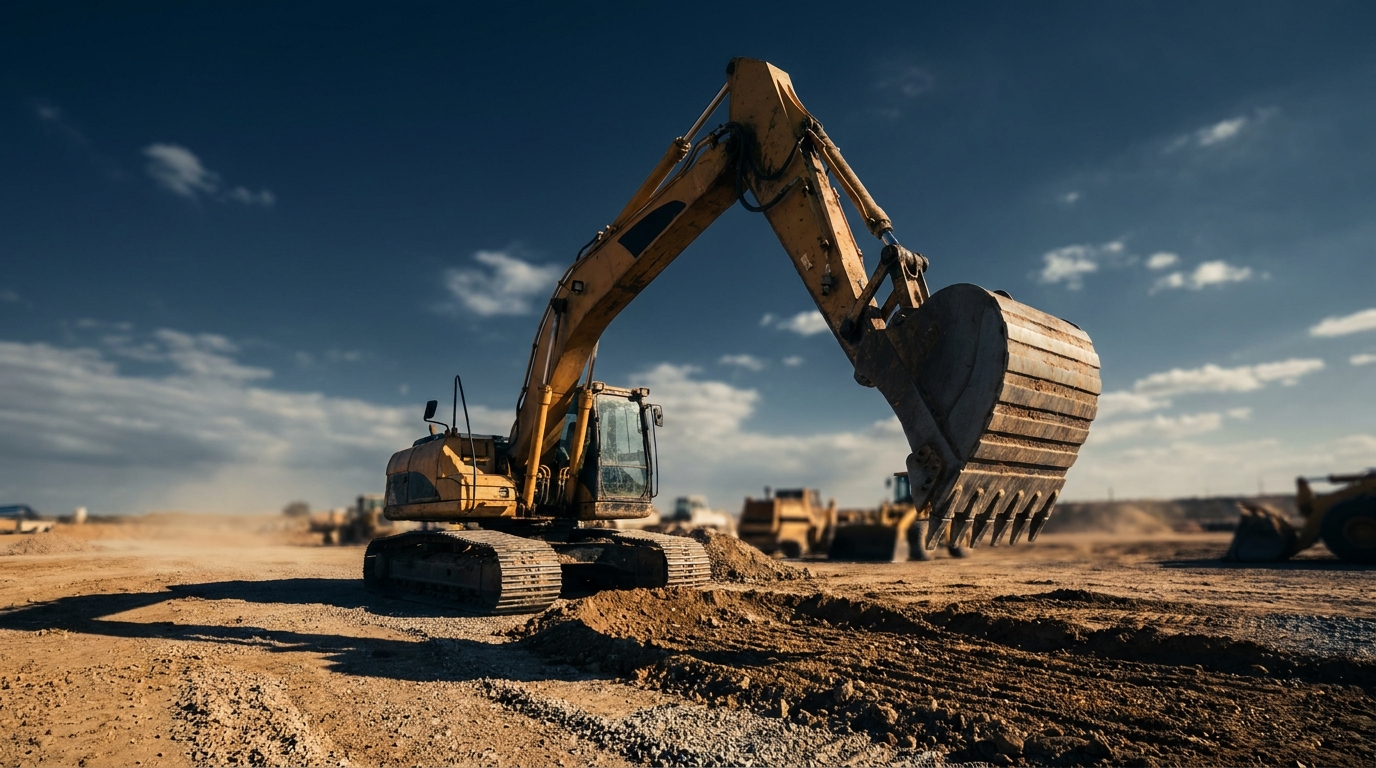
Construction equipment financing lets contractors buy excavators, backhoes, cranes, skid steers, and heavy machinery using the equipment itself as collateral. Most programs require a 550 or higher credit score, an active business, and a quote or invoice for the equipment. Same-day approvals are available on deals up to $100,000. Seasonal revenue gaps, which are common in construction, do not automatically disqualify you if you know how to present your 12-month picture.
Why construction equipment financing applications get evaluated differently
Construction is one of the industries lenders know least well. Most underwriters who specialize in equipment financing learned their trade on trucking, medical, and manufacturing deals. Construction has three quirks those industries do not share at the same scale.
First, seasonal cash flow. A residential contractor in the Midwest or Northeast may earn 70 percent of annual revenue between April and October. November through February, the bank statements look like a struggling business. They are not. But a lender reading three months of deposits in January sees a pattern that can read as distress.
Second, project-based income. Most construction companies get paid in draws tied to project milestones. You may have a signed contract for $600,000 of work and show minimal deposits in a given month because a draw is pending. That structure can confuse automated underwriting systems built around monthly recurring revenue.
Third, equipment residual value on heavy machinery is more variable than in trucking or medical. A 7-year-old backhoe's resale value depends on hours of use, maintenance history, and model year in ways lenders have to assess individually. Some lenders with less construction experience decline deals because they are not confident valuing the collateral.
The practical implication: apply with a lender who explicitly covers construction and can read seasonal patterns. GrowthPath's equipment financing program covers approximately 90 percent of industries and is built to handle the variability that project-based businesses bring.
What credit score, revenue, and time in business do you need?
Credit score: 550 or above for most programs. Equipment financing consistently carries one of the lowest credit floors among business loan products because the asset secures the loan. If your credit is in the 550 to 620 range, the equipment's age, condition, and value carry more weight in the decision. Above 680, you typically get the best terms and the fastest process.
Time in business: flexible on smaller deals. App-only approvals on deals up to $100,000 do not require a minimum operating history beyond having an active business. On larger purchases, lenders want to see that the business has been operating long enough to show payment patterns, typically one year or more.
Monthly revenue: there is no hard floor for equipment-only deals, because revenue matters less than collateral value. What lenders look for is that your deposits are consistent enough that the monthly payment does not represent a cash-flow emergency. On deals above $100,000, expect to provide three to six months of bank statements. Tax returns are generally not required. For the complete picture of how lenders assess eligibility across all equipment types, our post on equipment financing requirements covers the mechanics in detail.
How lenders handle seasonal revenue for contractors
This is the question most construction owners have, and most generic equipment financing guides do not answer it directly.
The standard underwriting approach is to average 12 months of deposits. A contractor who earns $1,200,000 per year but earns nothing November through February averages $100,000 per month. That average looks strong. The problem comes when a lender pulls only three months of bank statements during winter and reads the pattern in isolation.
Here is how to present your application if you have seasonal patterns:
Provide a full 12 months of statements even if the lender only asked for three. A lender reading three winter months in isolation may see a problem that does not exist. Twelve months tells the full story. If your business has a strong active season, apply during that window when possible. Statements from April through October show your true operating capacity.
Include signed job contracts or a backlog summary if you have them. A contract for $400,000 of work starting in March is meaningful evidence that the winter lull is cyclical, not structural. Lenders familiar with construction understand this distinction. The documentation is how you make sure yours reads correctly.
According to the Federal Reserve's Small Business Credit Survey, construction companies consistently rank among the industries that cite seasonal cash flow as a primary operating constraint. That is an industry reality, not a red flag, and lenders who work with contractors know the difference.
What equipment can you finance?
Virtually all heavy construction equipment is eligible: excavators, backhoes, bulldozers, motor graders, skid steers, compactors, mobile cranes, crawler cranes, boom lifts, scissor lifts, utility trucks, and flatbed work trucks. New, used, and private-party purchases all qualify. The seller can be a dealer, an auction house, or an individual contractor, as long as you have a valid quote, invoice, or bill of sale.
Equipment age is the variable that affects approval most significantly on construction machinery. New equipment is the most straightforward: value is known, depreciation is predictable, and most lenders fund at full purchase price for qualified borrowers. Used equipment in good condition with maintenance records and documented hours is standard. Older or high-hours equipment may require a larger down payment, typically 20 to 30 percent, because the lender needs confidence that the collateral retains enough value to cover the loan balance if payments stop.
One thing worth knowing: private-party purchases are allowed. If you are buying a used excavator from another contractor who is retiring the equipment, you are not limited to dealer inventory. You need a clear title and a bill of sale. That is all.
Equipment financing vs. a working capital line: which fits your situation?
This is a decision most growing contractors face, and the honest answer depends on what you are actually buying and why.
Use equipment financing when the purchase is a capital asset that will be on your books for years, the equipment will generate revenue directly on job contracts, and you want the asset to secure its own financing rather than drawing on your operating line. An excavator or a crane is exactly this kind of purchase. It has long useful life, strong collateral value, and it earns revenue on specific projects. Financing it separately protects your working capital for what it is designed for.
Use a revolving business line of credit when you need to bridge cash flow while waiting for a draw or invoice payment, the cost is for materials, payroll, or subcontractors rather than a capital asset, or you want flexible access you can draw and repay as projects cycle. A line of credit does not work well for a $200,000 excavator purchase because you would be tying up revolving capacity in a long-term asset.
The right setup for most growing contractors is both: equipment financing for capital assets, a line of credit for the operating cycle. Our post on working capital for contractors covers how these tools fit together on a project-based cash flow cycle, including how to avoid the common mistake of using short-term revolving debt to buy long-lived equipment.
Do you need a down payment on construction equipment?
Not always. Contractors with a 680 or higher credit score buying newer equipment often qualify with zero to 10 percent down. The 20 percent figure surfaces on older or high-hours equipment, or for borrowers close to the 550 credit floor. The down payment is primarily a function of how confident the lender is in the collateral's resale value: the more uncertainty about what the equipment is worth in a default scenario, the more they want from you up front.
For major construction equipment from recognized manufacturers, lenders tend to be willing to finance a high percentage of the purchase price on newer units because the resale market for excavators, motor graders, and cranes is active. A well-maintained 5-year-old excavator from a major manufacturer retains meaningful value and is easy to resell. That backstop reduces the lender's risk and reduces what they need from you up front.
One honest downside to name plainly: equipment financing only covers the purchase. If you also need cash for fuel, insurance, payroll, or materials while you are ramping up a new project, that is a separate product. Equipment financing and a working capital line solve different problems. Do not use one to do the job of the other.
Can your LLC apply for construction equipment financing?
Yes. Equipment financing is available to sole proprietors, LLCs, S-corps, and C-corps. Entity structure does not determine eligibility. For single-member LLCs and most small construction businesses, lenders run a personal credit check on the owner. The business and personal finances are effectively treated together on smaller deals. For larger corporations or multi-member LLCs, lenders typically require a personal guarantee from each owner with 20 percent or more equity in the business.
The entity structure does matter for tax treatment. Equipment purchases can often be expensed under Section 179 or taken as bonus depreciation, which can let a business write off a significant portion of the purchase price in year one rather than depreciating it over the asset's useful life. Talk to your accountant about the current-year limits and whether your business can use the deduction in the year of purchase. That deduction runs through your entity regardless of whether the equipment is financed or purchased outright.
How to apply and what to expect
For deals up to $100,000, the process is fully online and app-only. You will identify the equipment, provide a quote or invoice, and submit a short credit application. Same-day decisions are common on these deals. The soft credit pull prequalification does not affect your score, so you can check your position before anything goes to full underwriting.
For deals above $100,000, expect to provide three to six months of business bank statements. Tax returns are generally not required for equipment-only financing. The decision timeline is 2 to 5 business days. On construction deals with seasonal patterns, submit the full 12 months of statements and any supporting backlog documentation to get the most accurate underwriting read.
SBA financing is worth considering for established businesses with time to wait. An SBA 7(a) loan can be used for heavy equipment purchases and typically offers longer terms and lower overall cost than private equipment lenders. The tradeoff is time: SBA approvals take 30 or more days, compared to same-day to one week for a standard equipment loan. If you need to move on an equipment purchase at auction or through a time-sensitive deal, SBA is not the right tool. If you are planning months ahead and the savings justify the wait, it can be the lower total cost option. Our post on SBA loan requirements covers whether your business would qualify.
Construction equipment financing at a glance
| Factor | What lenders look at |
|---|---|
| Credit score | 550 minimum; best terms at 680 and above |
| Equipment age | New to roughly 15 years; older or high-hours equipment requires higher down payment |
| Down payment | 0 to 10% for strong credit on newer equipment; 20 to 30% for older or impaired-credit deals |
| Documentation | App-only for deals up to $100K; bank statements for larger amounts or shorter operating history |
| Tax returns | Not required for equipment-only deals |
| Seasonal revenue | 12-month average is standard; submit full year statements with backlog documentation |
| Approval speed | Same-day for app-only deals up to $100K; 2 to 5 days for larger amounts |
Check your construction equipment financing options → Equipment financing overview
Frequently asked questions
What are the best ways to finance construction equipment?
Equipment financing using the equipment as collateral is the most common approach and works well for contractors at most credit profiles, with same-day approvals available on deals up to $100,000. The main alternatives are an SBA 7(a) loan for lower overall cost on larger purchases with a 30-plus day timeline, a business line of credit for smaller tools or short-term needs, and a business-purpose HELOC for owner-operators with home equity who want the most flexible and lowest-cost capital. Which fits best depends on your credit score, how quickly you need to close, and the size of the purchase.
Do you have to put 20 percent down on construction equipment financing?
Not typically for borrowers with strong credit on newer equipment. Contractors with a 680 or higher credit score buying new or recent-model equipment often qualify with zero to 10 percent down. The 20 percent requirement shows up on older or high-hours machinery, or for borrowers near the 550 credit floor. If a lender is asking for 20 percent on a new machine for a borrower with good credit, it is worth getting a second opinion before you commit.
Can I use my LLC to get construction equipment financing?
Yes. LLCs, S-corps, C-corps, and sole proprietors are all eligible. For single-member LLCs and small construction companies, lenders typically look at the owner's personal credit score as the primary qualification factor on deals under $100,000. For larger deals or multi-owner entities, a personal guarantee from owners with 20 percent or more equity is standard. The entity structure does not block approval; it shapes how the guarantee is structured.
Will slow winter months hurt my construction equipment financing application?
Only if lenders evaluate those months in isolation. Provide 12 full months of bank statements with your application rather than the minimum three months many lenders request. Include signed job contracts or a backlog summary showing work scheduled for the coming season. Lenders who work with construction understand that seasonal revenue patterns are an industry standard, not a financial warning sign. The documentation is how you make sure your file reads the way your business actually operates.