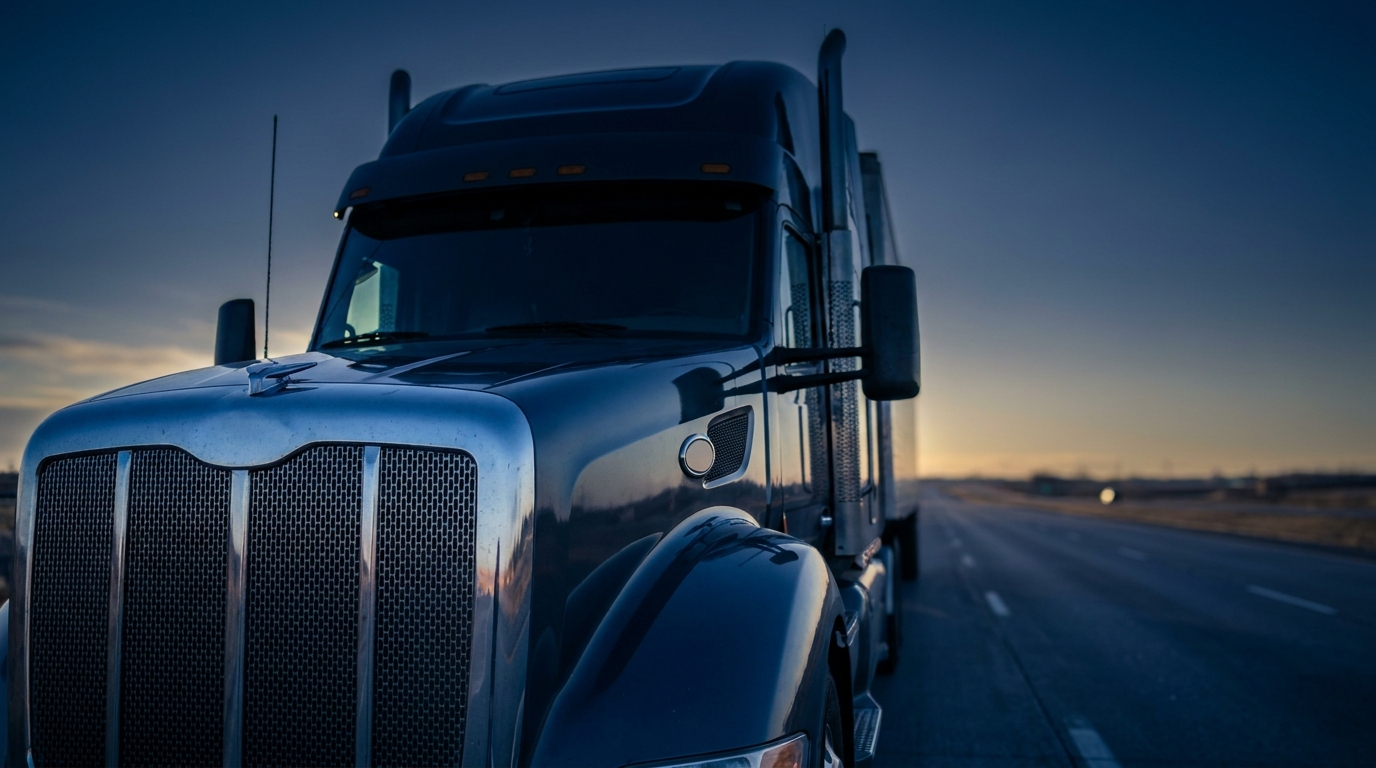
Equipment financing for trucking lets owner-operators and carriers buy or lease commercial vehicles, including semi trucks, trailers, and refrigerated units, using the equipment itself as collateral. Credit scores from 550 can qualify, lenders decide based on asset value more than personal income, and deals up to $100,000 often close the same day you apply.
How does equipment financing for trucking actually work?
The lender pays the seller, whether that is a dealer, a private party, or an auction house, and you take title to the truck. The lender holds a lien against that title until you pay off the loan. At payoff, the lien releases and you own the truck outright with no restrictions.
Because the truck itself secures the loan, the underwriting math is different from a working-capital or revenue-based product. Lenders are asking two questions: is the borrower creditworthy enough to make payments, and is the equipment worth enough to cover the loan if they do not? That second question is why equipment financing opens doors for borrowers who might get turned down for an unsecured line of credit. The collateral does a lot of the qualifying work.
You can use GrowthPath's equipment financing program for new trucks, used trucks, and private-party purchases across nearly every trucking category: Class 8 semi trucks, day cabs, sleeper cabs, flatbeds, refrigerated trailers, tankers, and specialty units. The application is fully online and the soft credit pull has no impact on your score.
The main alternative to an equipment loan is an equipment lease. With a loan, you own the asset and build equity as you pay it down. With a lease, you make lower monthly payments but return the truck at the end of the term, or buy it out at a predetermined price. For trucking specifically, a common commercial lease structure is a TRAC lease (Terminal Rental Adjustment Clause), which sets the residual value at origination and gives you a predictable buyout option at the end. Carriers who want to upgrade their equipment on a regular cycle often prefer this route. Owner-operators who plan to run the same truck for many years usually prefer a loan and full ownership.
What credit score do you need to finance a semi truck?
Most equipment lenders that specialize in commercial vehicles require a minimum credit score of 550. That is meaningfully lower than the threshold for most unsecured business loans, and it is lower than the 640 or higher that SBA programs typically require. The reason is the collateral: the lender can reclaim and resell the truck if you default, which limits their risk even if your credit history is imperfect.
Credit score affects terms more than approval status. At 550, you may qualify for smaller amounts, shorter terms, or a higher down-payment requirement. At 650 and above, lenders extend better rates, longer terms, and more flexibility on documentation. A score in the 700s typically gets you the most competitive terms and the fastest approval process. If you are on the lower end, the practical move is to check your eligibility now rather than guess: the prequalification is a soft pull with no score impact.
For a full breakdown of credit, time-in-business, and documentation requirements across equipment financing more broadly, see our post on what lenders actually require to approve an equipment financing application.
New vs. used semi trucks: how lender appetite shifts
Lenders are most comfortable with new trucks. The value is known, the depreciation is predictable, and there are no questions about condition or mechanical history. New Class 8 trucks typically run from $120,000 to $180,000 or more depending on configuration, and most equipment lenders will fund at full purchase price with a modest down payment for qualified borrowers.
Used trucks in the 1-to-7-year range are standard. Lenders fund these regularly, and the main variable is mileage: a truck with 400,000 miles at five years old is underwritten differently than one with 700,000 miles. Most lenders have an internal guide on acceptable age and mileage combinations. As a practical rule, trucks under 10 years old and under 600,000 miles rarely face issues on lender appetite, though terms may be slightly shorter than for a new unit.
Older trucks, roughly in the 10-to-15-year range, require more scrutiny. Some lenders cap at 10 years, others will go to 15 with a higher down payment, typically 20 to 30 percent rather than 10 to 15. Very high mileage on an older truck can make the collateral essentially unfinanceable at standard terms, because the lender cannot reasonably recover their loan balance through a resale if you default. If you are buying a truck in this category, plan for a larger down payment or expect to explore whether a business line of credit makes more sense as the financing vehicle. Our post on business line of credit requirements covers what that alternative looks like.
Owner-operators vs. fleets: do the requirements differ?
For a single owner-operator buying one truck, the application process is straightforward. Lenders look at your personal credit score, the truck you are financing, and your ability to make payments. Deals under $100,000 are often handled as app-only decisions, meaning no tax returns or financial statements are required, just the application and a basic review of credit. Funding can happen the same day.
For a small fleet adding multiple units or a larger purchase, lenders shift into a more complete underwriting review. They want to understand who your shippers or contracts are, what your revenue looks like, and whether your operating cash flow supports the payments on the new equipment. Bank statements covering three to six months are typically requested. This is not dramatically harder than single-unit financing, but it takes longer and requires a fuller file.
What does not change regardless of fleet size: you do not need W-2s or tax returns for equipment-only deals below $100,000. Above that amount, or for newer businesses with thinner credit files, lenders may ask for bank statements to confirm cash flow. To understand how lenders think about income verification more broadly, our post on what lenders actually check before they fund you walks through the full picture.
According to the Federal Motor Carrier Safety Administration, more than 97 percent of trucking companies in the United States operate 20 or fewer trucks. Most of GrowthPath's trucking clients fall squarely in this category: owner-operators adding a second unit, small carriers with three to five trucks, and regional haulers looking to retire aging equipment without taking on years of high payments.
What types of equipment financing work for trucking?
There are four structures most trucking businesses encounter:
Equipment loan. You borrow a fixed amount, make fixed monthly payments, and own the truck at the end. Interest you pay may be deductible as a business expense, and commercial trucks typically qualify for Section 179 expensing and bonus depreciation, which can let you write off a large portion of the purchase price in year one. Talk to your accountant about the current-year limits and whether your business can use the deduction in the year of purchase.
Equipment lease (operating lease). Lower monthly payments than a loan, but you return the truck at the end unless you exercise a buyout option. Good for carriers who prioritize keeping monthly expenses low and plan to upgrade trucks regularly. Interest on a capital lease is treated differently from an operating lease for accounting and tax purposes, which matters more once your fleet reaches a certain size.
TRAC lease. A Terminal Rental Adjustment Clause lease is a commercial vehicle-specific structure common in trucking. The residual value is fixed at origination, which gives you certainty about what a buyout will cost at the end of the term. Monthly payments are often lower than a straight loan. At the end, you pay the residual and own the truck, return it, or roll into a new unit. TRAC leases are not widely offered by all lenders; ask specifically about them if this structure interests you.
SBA 7(a) for equipment. SBA loans can be used for commercial vehicle purchases and offer longer terms and lower rates than most private equipment lenders. The tradeoff is time: SBA approvals typically take 30 or more days, which does not work if you need to move on a truck quickly. For established businesses with the time to wait, SBA financing can be the lowest total cost of the available options. Our comparison of SBA 7(a) vs. SBA 504 covers when each program makes sense.
How much does commercial truck financing actually cost?
Rates are deal-specific and we do not publish rate tables, because the honest answer is that your rate depends on your credit score, the age and value of the truck, the loan amount, the term, and the lender. What we can tell you is what moves rates in each direction.
Factors that push rates down: a credit score of 680 or higher, a new or nearly-new truck, a shorter loan term (48 months vs. 84 months), a full application with bank statements that show strong cash flow, and an established business relationship with the lender. Factors that push rates up: a credit score close to the 550 minimum, an older or higher-mileage truck, a longer term, and a lighter application with minimal documentation. The Federal Reserve's Small Business Credit Survey consistently finds that equipment financing is one of the more accessible forms of credit for small businesses, with approval rates higher than unsecured working capital products, because the collateral changes the lender's risk calculus.
Down payment requirements vary. New trucks with strong borrower credit often require 10 percent down. Used trucks, especially older ones, may require 15 to 20 percent. Lenders set down payment partly based on their assessment of the truck's resale value relative to the loan balance: the more confident they are that the collateral holds its value, the less they need from you up front.
Honest downsides to know before you apply
Equipment financing is not the right answer in every situation, and we would rather tell you that up front than sell you a product that does not fit.
The most important downside is the collateral risk. If your business hits a rough patch and you fall behind on payments, the lender can repossess the truck. That is not a hypothetical: it happens. If the truck is your primary revenue source, losing it creates a spiral that is hard to recover from. Before you finance, be honest about your cash flow cushion. If a slow month or a contract loss would make payments difficult, either buy a cheaper truck than the maximum you qualify for, or build more reserves before you take on the obligation.
A second limitation: equipment financing only covers the truck or trailer. If you also need working capital for fuel, insurance, maintenance, or payroll while you ramp up, that is a separate product. A business line of credit can sit alongside your equipment loan and cover operating expenses with no obligation when you are not drawing on it. If that combination fits your situation, the application at GrowthPath's general application covers both.
Third: the SBA route is genuinely better for some businesses. If you have the time to wait 30 or more days, an established business, and a credit score of 640 or above, SBA financing can save you real money over the life of a large equipment purchase. Do not default to the fast-approval equipment lender if a slower, cheaper option actually fits your situation.
Equipment financing for trucking: the quick checklist
| Factor | What lenders look at |
|---|---|
| Credit score | 550 minimum; best terms at 680 and above |
| Equipment age | New to roughly 15 years; older trucks need higher down payments or shorter terms |
| Down payment | 10 to 20% typical; higher for older or high-mileage trucks |
| Documentation | App-only for deals up to $100K; bank statements for larger amounts or newer businesses |
| Tax returns | Not required for most equipment-only deals |
| Approval speed | Same-day decisions on app-only deals up to $100K; 2 to 5 days for larger amounts |
| Industries | Approximately 90% of industries, including most trucking categories |
Check your trucking financing options → Equipment financing overview
Frequently asked questions
Can I get equipment financing for a semi truck with bad credit?
Yes, if your score is 550 or above. Equipment financing is one of the more accessible credit products for borrowers with imperfect credit because the truck itself secures the loan, which limits lender risk. Below 550, your options narrow: a co-signer with stronger credit, a larger down payment, or taking 6 to 12 months to build the score before applying. Checking your eligibility costs nothing and is a soft pull with no score impact.
How fast can commercial truck financing close?
App-only deals under $100,000 on established businesses often close the same business day. Larger loans or deals that require a full underwriting review, including bank statements and revenue documentation, typically close in 2 to 5 business days. SBA-backed equipment financing takes 30 or more days because of the government guarantee process. If you need to move quickly on a truck at auction or through a time-sensitive private sale, the equipment-only path is the one to use.
Can I finance a used semi truck that is more than 10 years old?
Some lenders will finance trucks up to 15 years old; others draw the line at 10. For older equipment, expect a higher required down payment, often 20 to 30 percent, and a shorter maximum loan term. If the truck is over 15 years old or has very high mileage, standard equipment financing may not be available and a business line of credit might be a more practical option. A line of credit does not require the vehicle to qualify as collateral, so age and mileage are not factors in approval.
Do I need to have a CDL to get equipment financing for a truck?
No lender requires a CDL as part of the loan application. If you are an owner-operator who will drive the truck personally, operating without the correct license creates legal and insurance risk that is worth resolving before you buy, but the CDL status itself does not appear on a credit application. For businesses that employ licensed drivers separately, this is a non-issue entirely. The lender cares about your creditworthiness and the truck's value, not your license classification.